
When you are trying to find addiction treatment that actually works, the path often feels like a winding road through a confusing maze of clinical jargon and empty promises. True healing requires more than just stopping a habit; it demands that we rebuild a life from the ground up, which is exactly why psychiatric rehabilitation programs offer the missing piece for long term addiction recovery and sustainable, health. By combining mental health stabilization with practical everyday skills, these services bridge the gap between initial detox and a meaningful, independent life.
- Simultaneous Care Saves Lives: Addressing mental health and substance use together through psychiatric rehabilitation programs drops relapse rates and builds a stronger foundation for long-term addiction recovery.
- Skill-Building Restores Independence: True recovery requires learning how to manage stress, secure stable housing, budget money, and maintain a job within your local community.
- Dual Diagnosis Rehab Benefits: Treating co-occurring disorders at the same time ensures that unresolved emotional pain or mental illness does not trigger a future substance relapse.
- Flexible Care Fits Real Life: Choosing between inpatient vs outpatient rehab options allows individuals to receive deep, focused healing or maintain their daily responsibilities while getting well.
- Community Integration Matters: Successful programs focus on helping people find affordable rehabilitation options and connect with local support networks right in their neighborhood.
What Are Psychiatric Rehabilitation Programs and How Do They Work
Many families feel completely lost when they start to look at care options. A common question people ask is what makes these services different from a standard detox center or a traditional therapy office. Psychiatric rehabilitation programs are structured frameworks designed to guide people toward long term addiction recovery by helping them regain the practical skills they need to live independently. Instead of only looking at medical symptoms, these programs focus on your daily life, your social skills, your housing situation, and your employment goals.
When someone is working toward long term addiction recovery, they quickly realize that just putting down a substance is not enough to change a life. You have to change how you interact with your environment, how you manage your daily stress, and how you build relationships. This is where psychiatric rehabilitation programs show their true value. They do not just give you a place to sit and talk about your past; they give you real, actionable assignments out in the real world.
Imagine trying to rebuild your credit, apply for an apartment near the Inner Harbor, or prepare for a job interview after years of active struggle. Dedicated psychiatric rehabilitation programs provide a case manager who walks through those steps alongside you to ensure sustainable, long term addiction recovery. In Baltimore, organizations like the Baltimore County Government Behavioral Health Outpatient Services offer community-based resources that focus on these exact daily living adjustments. By teaching people how to navigate local transportation, manage their medication schedules, and communicate clearly with employers, these services turn abstract healing concepts into concrete, everyday habits.
The Real Connection Between Mental Health And Long Term Addiction Recovery
It is almost impossible to talk about breaking a cycle of substance use without talking about what is happening in a person’s mind. When someone searches to find addiction treatment, they are usually looking for a way to stop an immediate crisis. However, staying well over time requires a deep look at underlying mental health conditions. By entering structured psychiatric rehabilitation programs, individuals can safely explore these root issues. After all, if a person suffers from severe anxiety, deep depression, or unmanaged trauma, they will often use substances to quiet their mind.
Using psychiatric rehabilitation programs means you are finally treating the root cause of the behavior rather than just patching up the surface symptoms. If you try to maintain long term addiction recovery while leaving a major mental illness completely untreated, you are essentially building a house on a shaky foundation of sand. The moment a heavy emotional storm hits, the structure is highly likely to collapse.
When you look at a successful psychiatric rehabilitation success rate, you will see that the common thread is always a strong emphasis on mental stability. Comprehensive psychiatric rehabilitation programs provide the tools necessary to achieve this balance. True recovery means learning to recognize your internal triggers before they turn into physical actions. It’s about having a concrete game plan ready for those quiet, high-risk moments—like a rainy afternoon when your thoughts start spinning out of control—so you naturally reach for a healthy routine instead of your old coping mechanisms. This behavioral shift is what transforms a temporary break from substances into a true lifestyle of long term addiction recovery.
Exploring the Distinct Dual Diagnosis Rehab Benefits
When a person struggles with a mental health disorder and a substance use challenge at the same time, professionals call it a dual diagnosis. Trying to treat one while ignoring the other is one of the biggest reasons standard treatments fall short. Recognizing the specific dual diagnosis rehab benefits can completely alter the path of a person’s recovery journey. When a care team treats both conditions as interconnected parts of a single puzzle, the entire healing process becomes far more reliable.
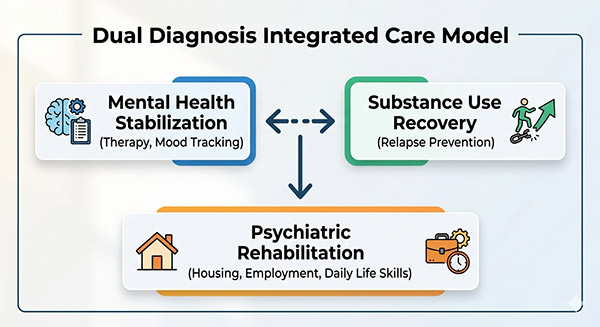
One of the top dual diagnosis rehab benefits is the complete elimination of conflicting advice from different doctors. In an integrated program, your therapist, your case manager, and your medical team all work from the exact same playbook. This cooperative approach helps individuals understand how their mood swings directly affect their physical cravings. By discovering these personal connections, patients learn that managing their mental health is actually their best defense against a relapse.
Furthermore, experiencing these dual diagnosis rehab benefits means you receive specialized peer support from people who truly understand your specific struggles. Sitting in a room with others who know exactly what it feels like to manage clinical depression while fighting substance cravings creates a deep sense of shared understanding. This collective wisdom helps break down the isolation that so often derails long term addiction recovery.
Measuring the True Psychiatric Rehabilitation Success Rate
When families are investing time, money, and emotional energy into a program, they naturally want to know about the numbers. They want to see a high psychiatric rehabilitation success rate before they commit. However, measuring success in mental health and recovery is not quite as simple as looking at a scoreboard. A true psychiatric rehabilitation success rate is measured by the tangible improvements in a person’s overall quality of life over an extended period.
- Stable Housing Retention: Looking at how long an individual maintains a safe, independent apartment after finishing a program.
- Consistent Employment Status: Tracking the ability to secure a job and hold onto it for six months, a year, or longer.
- Reduced Emergency Room Visits: Measuring the drop in hospital visits and crisis interventions over time.
- Stronger Social Connections: Evaluating the rebuilding of healthy relationships with family members and sober friends.
- Long-Term Sobriety Milestones: Counting the consecutive months and years a person remains completely free from substance use.
When you analyze a regional psychiatric rehabilitation success rate, you notice that long term addiction recovery becomes much more achievable when individuals feel useful and connected to their neighborhood. Success is found in the quiet moments: waking up on time, packing a lunch, taking your prescribed medication, and heading off to a local job in Baltimore. Programs like the Seventy Times Seven Wellness Mission in Baltimore focus heavily on these community-based milestones, helping individuals find a true purpose that keeps them anchored when life gets challenging.
Comparing Inpatient Vs Outpatient Rehab Options for Your Care
Choosing the right setting for treatment is a major decision that requires an honest look at your current life situation, your medical needs, and your level of stability. Comparing inpatient vs outpatient rehab options is the best way to determine which environment will provide the most effective support. Neither option is universally better than the other; rather, it is about finding the exact level of structure that matches your current stage of healing.
| Feature or Care Focus | Inpatient Rehabilitation Programs | Outpatient Rehabilitation Programs |
| Living Arrangement | Living full-time inside a secure, monitored clinical facility | Residing at home or in a local sober living environment |
| Daily Supervision | Continuous medical and emotional support around the clock | Scheduled sessions throughout the week with independent evenings |
| Distraction Level | Complete separation from everyday triggers and stressors | Navigating real-world environments while attending therapy |
| Best Suited For | Initial stabilization, acute crises, or severe dual diagnosis | Individuals returning to work, school, or family duties |
| Typical Duration | Short-term focused stays lasting anywhere from 30 to 90 days | Extended support continuing for many months or even years |
Weighing inpatient vs outpatient rehab options requires a realistic look at how much external control you need to stay safe. If your home environment is filled with high stress or active drug use, an inpatient stay offers a crucial sanctuary where you can focus entirely on your mental health. On the other hand, outpatient care allows you to practice your new psychiatric rehabilitation programs skills in real-time while still returning to a safe home base at night.
Navigating Affordable Rehabilitation Options in Your Local Area
A major worry for almost everyone seeking care is the overall cost of treatment. Many people assume that high-quality psychiatric rehabilitation programs are completely out of reach for regular working families. Thankfully, there are many affordable rehabilitation options available if you know exactly where to look. In Maryland, companies like Carelon Behavioral Health of Maryland work closely with state Medicaid systems and local providers to offer specialty services that cover mental health and substance care without draining your bank account.
Finding affordable rehabilitation options often starts with reaching out to your county health department or looking into public insurance programs. Many community centers offer sliding-scale fees that adjust your bills based on your household income. This financial flexibility ensures that your financial situation does not prevent you from receiving top-tier dual diagnosis rehab benefits.
When searching for affordable rehabilitation options, remember that investing in comprehensive psychiatric rehabilitation programs now saves a massive amount of money down the line. Chronic hospital visits, emergency room care, legal fees, and lost wages from being unable to work are far more expensive than a structured program. True long term addiction recovery gives you the stability needed to build a steady income, making affordable care an essential step toward financial and personal freedom.
Actionable Steps to Find Addiction Treatment That Works
When you are ready to take action, the initial step can feel incredibly heavy. The process to find addiction treatment should be broken down into small, manageable tasks so you do not feel completely crowded by choices. You deserve a care plan that respects your humanity and addresses your specific mental health needs.
Steps to Secure Effective Treatment:
- Verify Your Insurance Coverage
(Call the number on your card to check mental health benefits) - Complete a Comprehensive Dual Evaluation
(Get assessed for both mental health and substance habits) - Tour Local Facilities in Baltimore
(Check out the environment, safety, and community culture) - Begin Your Tailored Rehabilitation Journey
(Commit to daily skill-building and long-term milestones)
As you work to find addiction treatment, always ask potential providers about their long term addiction recovery plans. Do they help you find safe housing after your initial program ends? Do they offer job placement assistance or resume workshops? If a center only focuses on your first 30 days without considering your long-term life skills, they are missing the core philosophy of psychiatric rehabilitation programs. Look for a team that is willing to invest in your entire lifestyle recovery.
Rebuilding Daily Life Through Skills And Community Integration
True healing happens out in the open air, not just inside a therapy office. When you are looking at the impressive psychiatric rehabilitation success rate of top-tier community programs, it is because they emphasize social connection. For example, programs like the 70×7 Wellness Mission in the Baltimore area understand that a person needs a safe place to go, a good friend to talk to, and a meaningful job to do every day to stay sober.
Learning how to cook healthy meals, manage stress without substances, and build clean boundaries with old acquaintances are the real tools of recovery. Psychiatric rehabilitation programs provide a safe laboratory where you can practice these skills with professionals who offer feedback without judgment. When you combine these daily habits with the medical advantages of dual diagnosis rehab benefits, you create a protective shield around your sobriety.
Furthermore, having access to inpatient vs outpatient rehab options means you can adjust your level of care as your confidence grows. You might start in a highly protected environment and slowly transition to an independent outpatient routine. This gradual return to community life ensures that you never feel suddenly dropped back into the real world without a safety net.
Understanding the Long Term Value Of Structured Aftercare Plans
The final phase of a truly effective program is not a hard stop; it is a smooth transition into long term addiction recovery aftercare. True psychiatric rehabilitation programs always include a thorough plan for what happens next. This plan might involve weekly check-ins with a case manager, ongoing outpatient therapy, or joining a local recovery group in your neighborhood.
“True recovery is not a single event; it is a continuous series of small, daily choices to care for your mind, your body, and your community.”
When people take the time to find addiction treatment that includes structured aftercare, their personal psychiatric rehabilitation success rate climbs dramatically. Participating in continuous psychiatric rehabilitation programs ensures you still have a team checking on your progress months after you leave the main facility, keeping you accountable. It provides a reliable space to troubleshoot life challenges before they grow into full-blown crises, preserving your hard-earned progress for the years ahead.
Need Professional Help?
If you or someone you care about is ready to break the cycle of substance use and manage an underlying mental health condition, our dedicated team in Baltimore is here to help you move forward. We specialize in comprehensive psychiatric rehabilitation programs that combine mental stabilization with real-world lifestyle skills to give you the highest possible psychiatric rehabilitation success rate. Do not wait for things to get harder before you reach out for help. Call our local intake line right now at 410-624-5037 to speak with an empathetic specialist who can guide you through our affordable rehabilitation options and help you reclaim your life.
Finding Your Path to Lasting Hope and Stability
Choosing to enter psychiatric rehabilitation programs is an act of incredible courage. It means you are choosing to stop running from pain and start building a real life worth living. By using the immense dual diagnosis rehab benefits and selecting between inpatient vs outpatient rehab options, you can tailor a recovery path that perfectly matches your personal needs.
Real long term addiction recovery is fully possible when you have the correct tools, a supportive community, and an integrated care plan that treats you as a whole person. Enrolling in dedicated psychiatric rehabilitation programs can offer that exact foundation. Lean on the resources around you, explore the affordable rehabilitation options in your neighborhood, and take that initial step toward wellness today. Your future self is waiting for you to make this choice.